

Build the System, Don't Subscribe to It: In Conversation with Constant Dullaart
On DIY across generations
Constant Dullaart makes work about the machinery beneath the image – the communication and image-processing systems, and the handful of corporations whose platforms now shape how the world is seen. He works both online and off, testing the limits of what can be manipulated inside Google, Facebook and Instagram, and once founded his own acerbically self-aware hardware company, DullTech™, partly to see how the devices we depend on are actually made.
No stranger to the way media art gets (un)made and passed on, Dullaart has taken up these questions with LI-MA. In 2017, alongside DullTech, and together with Rhizome and the Dutch Digital Heritage Network, LI-MA built ArtHost [1], a preservation service for net art – hosting artists’ files, source code and domain registrations so that a work need not die when a server is switched off or a domain lapses. The following year, LI-MA presented his fake-profile army The Possibility of an Army in the exhibition Cultural Matter [2]. And this year, LI-MA drew on its own collection for his hybrid mini-festival CONTENT MACHINES - Requies [3], setting today’s automated image-making against its long prehistory in the LI-MA collection.
He also belongs to a generation that came up on the open web and believed, for a while, that it would remain open – that people could programme themselves, that the tools would remain in their hands. Much of his recent thinking is an accounting of what happened to that belief. How does a do-it-yourself practice survive being passed from one generation to the next, and what does a younger artist inherit now that the open territory has a landlord?
Tom Klinkowstein was one of them: his 1980 slow-scan television work is among the early pieces in Pioneers of Media Art at Nxt Museum, drawn from the MonteVideo archive that LI-MA now holds. Speaking to Het Parool in the context of that exhibition, he said working with slow-scan television felt like the way people met AI a few years ago – a technology still on the edge of awareness, before anyone quite knew what it was.
Building your own tools was, at the time, a form of autonomy. Drawing from the trailblazing MonteVideo archive, the exhibition Pioneers of Media Art at Nxt Museum traces the origins of media art through experimental works that pushed the boundaries of technology, sound, and moving image long before the digital age. From early video synthesis to telecommunications experiments, these artists reveal how innovation, curiosity, creative exploration, and technologic subversion laid the foundations for today’s media culture. At a time when museums, and the art world writ large, puzzle over the future, the exhibition looks to the past, not as a bastion of purity and tradition, but as a transgressive and radical space of experimentation.
That impulse hasn’t gone away; it runs through a lot of current practice, from artists training their own models to the movements around self-hosting and local, scalable infrastructure. So we asked Dullaart where that impulse comes from, what it costs to keep alive, and what artists hand down to one another across generations.
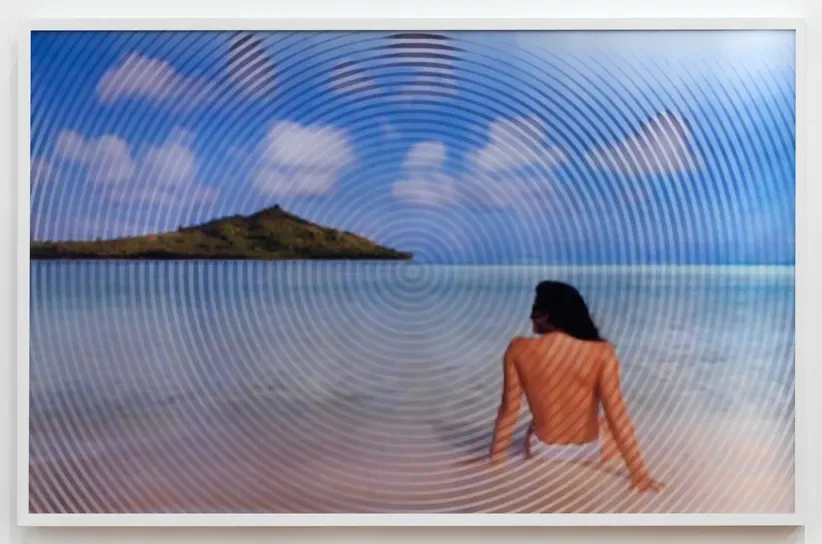 Jennifer in Paradise (Halftone_Circle). Photo: Gert Jan van Rooij.
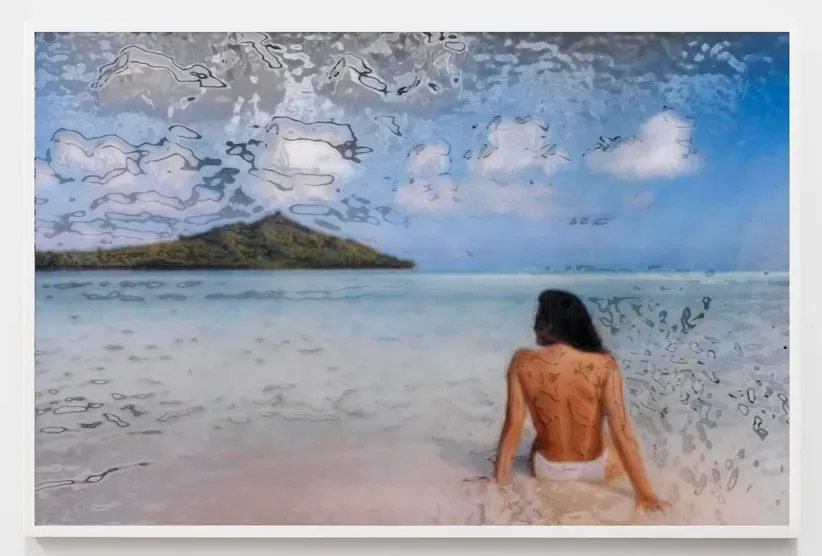 Jennifer in Paradis (PaintDaubs_Sparkle). Photo: Gert Jan van Rooij
You came up making work that ran on the open web, often outside institutions. For an artist starting now, is that DIY position still available, or has the infrastructure closed around it?
I think it’s still available, but you have to want it now, it doesn’t happen to you anymore. When I started, publishing your own website was just what you did, the audience was already out there on the open web. Today if you publish on your own domain it can feel like opening a gallery in a forest. I often think about Thurn und Taxis, this aristocratic family that ran the postal system in Europe, they even had their own military to protect the integrity of the mail. They controlled the communication infrastructure completely, and eventually that got nationalised. The platforms are in that position now, except nobody nationalised anything, and we never elected them, we only elected them by way of market, by adding functionality to our lives.
My generation really believed in a kind of technological Esperanto, that people could program themselves, that we would all control this ourselves. And we watched that fade away because there was too much money to be made. So yes, you can still do it yourself, the tools are cheaper than ever. What you don’t get for free anymore is attention. But I also think making something public has always meant making the public itself, so maybe that was never supposed to be free.
Much of your work is about the infrastructure beneath the surface. What first drew you to the infrastructure rather than the surface? Does working critically from inside still feel possible?
For me the process is part of the medium. If you would analyse my work like a painting, the platform would be part of the paint. So I never really experienced it as a choice between surface and infrastructure, the infrastructure is where the meaning gets made.
When I found Jennifer in Paradise, the first image ever edited in Photoshop, I didn’t change the image at all, I was interested in changing how it was read. The first thing this software was used for was cutting out an anonymous woman to demonstrate a product. I thought it was important to point that out. And once you work like that, everything around the image becomes material. The followers, the comments, the SIM cards that are used to verify fake accounts, I had a hundred thousand of them in my studio at some point, and sorting them you realise these are physical artifacts of an industry that manufactures audiences.
I sometimes describe what I do as being a participatory cultural anthropologist. I join in on the game. I bought the followers, also for myself, I registered the accounts, so I’m implicated in the same system I’m looking at. I don’t think there’s an outside position anymore, and I’m honestly more suspicious of work that pretends there is one than of work that shows its own receipts.
How do you understand the DIY drive today – less as nostalgia for the past than as a way of staying independent and responsive rather than dependent and passive? Does that kind of improvised, self-authorised entry still exist or has everything been professionalised?
The careers got professionalised, I’m not sure the making did. You can still self-authorise, my students do it all the time, open models, a used GPU, a soldering iron. I make them build these systems themselves instead of consuming them, because I think that’s the only way to understand what you’re inside of. What’s different is that the MonteVideo artists were working before the tools had product managers. Every tool now arrives with an intended use and a pricing tier, so improvising mostly means misusing, working against what the interface wants from you.
That was also part of why I started DullTech. It began as a joke on my name obviously, but it was really a way to get access to the Chinese factories where our technology is produced, because we have all these devices and standards and we have no idea how they’re developed, where they come from, how they get to us. Technology should be boring, it has been exciting for way too long. And I think that kind of stubbornness, refusing to accept the device or the platform as a given, is what self-authorisation looks like now.
ou’ve worked with authenticity and fakeness for years. In a landscape of synthetic media, has that concern sharpened, or become so ambient that the critique no longer has any bite?
I think saying that something is fake has become a bit like a weather report. Everybody knows. What still interests me is how the feeling of the real is manufactured, because that never stopped, it just got industrialised. There’s this great example I keep coming back to, when MIDI came out in the eighties, suddenly instruments could play in perfect sync, and it sounded terrible, too perfect, robotic. So they built in a function called humanise, small programmed timing errors so it would sound like a person played it. They programmed it to sound human. And you see something very similar now with AI speech, the little hesitations and imperfections that make you sympathise with the system, find it likable. That’s what I mean by manufactured authenticity.
With the follower works and the army it was the same question really, people copy the dominant opinion around them, and if you do it well nobody can tell whether that opinion is real or bought. So my answer to all of this has become disclosure. For my recent video work I publish which models, which datasets, which methods, a bit like a painter listing pigments. Not to be absolved, but because I think refusing the magic trick is where the critique still has teeth.
Tom Klinkowstein describes working with a technology while it was still on the edge of people’s awareness, before anyone quite knew what it was, which he compares to AI today. What do you make of this comparison?
I recognise the feeling he describes, working with something most people around you can’t name yet. And I do think that moment, before a medium hardens, before there are rules, is the most productive moment for artists. But I would push back on one thing. Slow-scan and the early telematic experiments happened on genuinely unowned territory, there was nothing commercial there yet. AI arrived already enclosed. It was capitalised at a scale no medium has ever seen at its birth, and the companies that own the models also sell us the maps of the territory.
So yes, we’re again at the edge of people’s awareness, but this time the land under that edge already has a landlord, and we were only consulted by way of market. That’s a very different starting position, and I think it’s important to say that, because otherwise the comparison becomes a way of borrowing the innocence of that earlier moment.
The artists whose work LI-MA holds from the MonteVideo years worked with unstable, throwaway technology and largely expected it to be ephemeral. Your generation had to relearn that condition on the web. What did they understand about working with disposable technology that got forgotten in between?
They understood that the work was the event, not the object. The tape and the circuit were carriers, they were expected to degrade. I think my generation forgot that around the moment net art wanted institutional recognition. We started treating websites as stable objects, and then platforms died under our work, browsers deprecated our plugins, and conservation became an emergency. That emergency is why I approached LI-MA and initiated ArtHost, which we developed together through DullTech.
The idea was simple: you hand over your files, your source code, documentation, your domain registrations, and the work gets hosted, monitored, kept accessible, so a piece doesn’t die because somebody forgot a twelve euro domain invoice. We also worked on documenting these works beyond the technical specifications, filming the reception situation, the interaction, because the work was never just the code. And then the uncomfortable part: there was too little interest to keep it financially viable. Everybody agrees this history matters, but almost nobody wants to pay rent for its survival, while we all pay rent to the platforms without thinking about it. So maybe what got forgotten between then and now isn’t a technique at all, it’s an economy of care.
 CONTENT MACHINES - Requies promotional image.
CONTENT MACHINES set today’s AI-generated content against a much longer history of artists working with automation and generative systems. What made you want to frame the present moment as a continuation rather than a rupture?
I think “unprecedented” is mostly a sales pitch. It’s what you say when you want exemption from history, from comparison, from regulation. Artists have been delegating authorship to processes for at least sixty years, through instruction-based work, cybernetics, plotter drawings, and when you place generative AI inside that lineage two things happen. Artists get their genealogy back, and the technology loses its alibi.
I like thinking about it through the woodcut. Where does the artwork reside, in the block or in the print? With generative systems the printing plate can keep changing, a model can produce endless variations, but somebody still made the plate. That’s how I work with my students too, they build the model, the system, and the artistic work is in making the plate, not in any single print. And once you see it that way, the interesting questions turn out to be the old ones, about labour and control and credit, just at industrial scale now. We already have the critical tools. We just have to refuse the amnesia.
During Content Machines, we saw works by artists delegating authorship to a process or circuit decades before generative AI. When you look at that work now, what reads as prescient, and what reads as of its moment?
What reads as prescient to me is the delegation itself, and especially the fascination with the moments where the process exceeds the instruction, the drift, the failure states. That’s still exactly where the interesting work happens with AI. Also the modesty of it, letting a small system be a complete work, I find that very sympathetic in a time of maximum scale.
What reads as of its moment is the faith that the machine was a neutral partner. There was this cybernetic optimism, the feedback loop as something inherently liberating, and I don’t think that survived contact with platform capitalism. Those artists delegated to circuits they built and understood themselves. Most people now delegate to systems owned by others, trained on us. The gesture looks the same, the power relation is reversed. And that reversal is really what I’m trying to teach around, which is why I keep insisting the students build the system rather than subscribe to it.
The festival’s subtitle is Requies, rest or a requiem. What is being laid to rest, and what’s being mourned, in a show about machine-generated content?
What’s being laid to rest, I think, is the assumption that content implies a human somewhere behind it. That default died quietly and nobody held a funeral, so we held one. What I personally mourn is more specific. The amateur web, the idea that publishing was one person addressing other persons. And attention as something you gave, instead of something that gets harvested from you. I’ve been in this territory before actually, I once designed a monument for the deleted soldiers of the propaganda wars, all those fake accounts that get erased in the platform purges, so mourning manufactured presences is somehow familiar. But requies is also just rest, and I find there’s real relief in admitting that the feed is machinery. Once you stop expecting a human on the other end, you can decide much more precisely where you actually want one. That part isn’t sad to me at all.
If a young artist asked you how to work independently today, what would you answer?
Develop your voice first, the audience comes later, not the other way around. I worked in television where the logic was reversed, first build the audience, then find something to say, and social media imported exactly that logic into art, and I think it made a lot of work more predictable.
Then, practically: own a domain and keep it for life. Treat the platforms as venues you perform in, not as home.
Read the terms of service of every tool you depend on, once, completely, it will radicalise you faster than any theory seminar.
Learn just enough of the technical layer that nobody can lie to you about it.
And don’t do it alone. I can’t tell anyone to go build their own Facebook, but I can say start your own gallery, your own radio station, publication, platform, bar.
Build your own public, even if it’s small at first, until a genuinely interesting conversation can happen. Independence [is] shared infrastructure. Making something public also means making the public itself.
Pioneers of Media Art at Nxt Museum has been extended until 10 January 2027.
Notes
-
ArtHost is a preservation service by LIMA developed in cooperation with DullTech that anyone can use to save complex digital and online artworks. By sending your documentation, source code, files and domain registrations we take care of the sustainable preservation of your artwork.
-
In 2016, Constant Dullaart embarked on an online performance commissioned by Schirn Kunsthalle in Frankfurt, drawing inspiration from a historical army of mercenaries that fought in the American Revolutionary War. Specifically, the Dutch artist focused on the Hessian troops, who were originally hired by the British to fight for American independence. To challenge the American social media giants, Dullaart created thousands of fake Facebook profiles using the names of these soldiers, forming his own army. This project delved into the shadowy realm of fake accounts and the attention economy. Dullaart collaborated with partners in countries like Bangladesh, the Philippines, and ultimately Pakistan to execute this performance. While the social media intervention was “real,” its primary operation took place on Pakistani soil and databases. Eventually, Facebook’s troops eliminated the army Dullaart had created.
-
CONTENT MACHINES - Requies was a festival, in collaboration by DISTANT.gallery and LI-MA, asking how algorithmic systems shape contemporary art practice and cultural production. It took place in June 2026, in Amsterdam.
Header: Constant Dullaart during Transformation Digital Art 2026. Photo by Alex Heuvink.