
Reflections on the Project Connecting Media Art
What do Linked Open Data mean in practice for media art collections
In the Connecting Media Art project, LI-MA transforms its diverse media art collection into Linked Open Data, making complex, evolving works more accessible and interconnected. Petra Dreiskämper, Joost Dofferhoff, and Jaap van der Kreeft explain how they combine expertise in data, conservation, and technical infrastructure to ensure media artworks are described, and widely discoverable.
Media art does not behave like most other forms of cultural heritage. It moves between software and hardware, installation and performance, fixed files and live interaction. A single artwork may exist in several versions, depend on technologies that are already obsolete, and change every time it is presented. For audiences, that instability is often part of the appeal. For collections, it makes documentation, preservation and access considerably more complex.
How, then, can these works be described in a way that does justice to their complexity while also allowing them to be discovered and understood beyond the walls of a single institution?
Linked Open Data offers one response. In practical terms, it allows collection information to be published in a structured, machine-readable format so that artworks, artists, exhibitions, technologies and contexts can be linked across databases. Instead of remaining isolated records, collections become part of a wider network of knowledge. For researchers, curators and interested audiences, this means richer connections and new pathways into media art’s histories and practices.
For media art collections in particular, this approach is not simply a technical refinement. Traditional collection systems were developed with relatively stable objects in mind. Media artworks, by contrast, often unfold across multiple versions, installations and technical embodiments. Capturing those relationships requires a model that can reflect conceptual, technical and material layers without flattening them.
Through the project Connecting Media Art (2025–2026), LI-MA has been working to address precisely this challenge. In 2025, LI-MA received a grant as part of the Verbonden Digitaal Erfgoed programme of the PICA Foundation, in collaboration with the KB, National Library of the Netherlands. The project focuses on connecting the digital heritage collections of LI-MA and the Van Abbemuseum, with the ambition of establishing a robust standard for sustainable identifiers and publishing a linked dataset that can be reused beyond the originating institutions. As a centre specialising in the preservation and documentation of media art, LI-MA brings hands-on experience to the development of these models. The aim is not only to refine data structures, but to ensure that the realities of artistic practice are reflected in the way works are described and connected internationally.


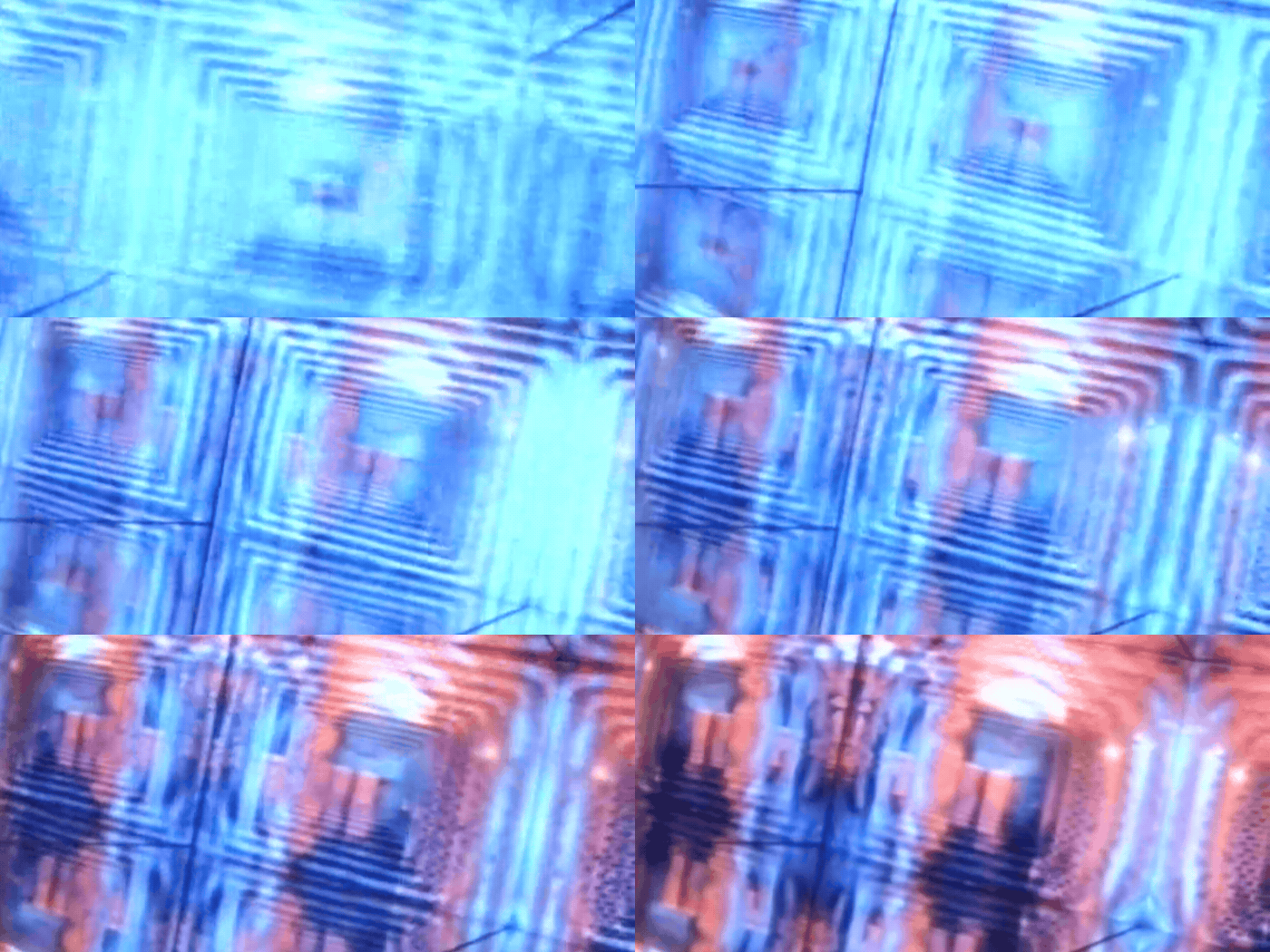
Manuel Saiz, Video Hacking (1999). In collection: LI-MA.


Chill Cave schema.
The project is carried by a small team working from different sides of the collection. Data analyst Petra Dreiskämper focuses on transforming LI-MA’s collection data into Linked Data, while registrar and assistant conservator Joost Dofferhoff works directly with the collection records that feed the new model. The technical implementation is handled by technician Jaap van der Kreeft, who is responsible for converting the existing database and building the infrastructure that allows the data to be published as Linked Open Data.
So, what is Linked Open Data?
“Linked open data is a way of publishing the data that’s inside your database in a structured way so it becomes readable for other machines and other people as well,” says Dreiskämper. “If you publish it in a structured way that uses an ontology, as it's called.” An ontology is a knowledge organisation system designed for cataloging and describing media art, “a certain schema of things that simply mean that if it's a title you call it a title, if it's a name you call it a name, if it has a date you put a date on it – you get structured data in a format that other machines understand,” adds Dreiskämper. “And if you do that, other people can connect to it.”
At the core of this initiative lies a structural issue. Digital art information is often described using local systems, varying terminologies and inconsistent identifiers. This fragmentation limits discoverability and makes it difficult to connect artworks meaningfully across collections. Connecting Media Art addresses this gap by applying Linked Open Data principles and aligning with the guidelines of the Dutch Digital Heritage Network (NDE). Collection information will be linked to standardised terms via the NDE Terminology Network and made discoverable through the NDE Dataset Registry, positioning media art data within a wider national and international infrastructure.


Petra Dreiskämper, Joost Dofferhoff, and Jaap van der Kreeft.
“Media art is still evolving and it exists in so many different forms,” explains Dofferhoff, which makes it very complex to model. Works frequently exist in multiple versions and technical embodiments, and their documentation spans conceptual, material and contextual layers. Within the project, LI-MA applies the FRBR/WEMI-based Four Level Artwork (FLA) model to structure these relationships in a way that remains faithful to artistic practice while enabling interoperability. LI-MA’s FRBR/WEMI-based data model – designed to describe media artworks across the interconnected levels of Work, Expression, Manifestation and Item – was confirmed as a powerful but demanding instrument.
What does it actually mean when collection data becomes connected? For van der Kreeft, the shift is easiest to understand from the user’s perspective. If information is described in a structured format that machines can understand, it no longer remains limited to a single institutional website. Instead, it becomes part of a much larger ecosystem in which data from different collections, platforms and knowledge bases can interact. A researcher searching for works by Marina Abramović, for example, would no longer need to move between separate catalogues. One search could reveal where those works are held, how they relate to each other, and where they can be accessed. In that sense, Linked Open Data is not only about improving internal systems; it fundamentally changes how media art becomes visible to the public.
Media art is particularly well suited to this development precisely because it is still evolving, argues Dreiskämper. Unlike books or paintings, which have long-established cataloguing traditions, media artworks continue to shift in form, technology and presentation. A work that began as a single-channel video in the 1960s may now exist as a digital file, an installation, a projection, or a version adapted for new hardware. Rather than treating this variability as a problem to be simplified, the project approaches it as a strength. Media art forces institutions to think beyond static objects and instead describe relationships, transformations and versions over time. In that sense, it becomes a testing ground for the future of digital heritage more broadly. Besides, as Dofferhoff explains, “we could be making a data model now and in five years a new art form might appear that doesn’t fit.”
Another key aspect is flexibility. Earlier collection systems often reduced artworks to only two layers – the work itself and the physical object that carried it. For media art, this quickly proved insufficient. New formats replaced old ones, and technical updates created new versions. Often, the conceptual identity of the artwork remained constant even as its material form changed. The FLA model used in the project makes it possible to distinguish between these layers more clearly, while still keeping them connected. Instead of forcing complex works into simplified categories, the model reflects how media artworks actually exist: as evolving constellations of files, versions, presentations, and concepts.
The project is not simply about building a better database. It is about rethinking how media art can remain accessible in the long term. Digital works are often easier to share than physical objects, but only if they are described in a way that allows them to be found and understood. When the documentation is fragmented or inconsistent, accessibility quickly becomes an illusion. Linked Open Data addresses this by creating a shared structure that makes information usable beyond a single institution.
At the same time, the urgency of this work is shaped by a rapidly changing technological landscape. Artificial intelligence can now generate and interpret large amounts of information, but this does not necessarily make structured data obsolete. On the contrary, reliable and verified data becomes even more important. If AI systems increasingly rely on publicly available information, the quality of that information will directly influence how media art is represented and understood in the future. (Dofferhoff recalls that LLMs sometimes erroneously name Sweden as the birthplace of media art.) In this context, projects such as Connecting Media Art do not only preserve the past; they also shape how cultural heritage will be interpreted in the years ahead.
One of the most important insights emerging from the project is therefore its simplicity. Rather than building an entirely new model from scratch, the team worked with an existing framework and adapted it to the specific needs of media art. This decision not only makes the model easier to understand for other institutions, but also increases the chances that it can be adopted more widely. The goal is not to create a system that only works for LI-MA, but one that can support collaboration across collections and countries.
By developing a standardised yet adaptable framework for digital art, the project contributes to the sustainable preservation of media art and supports new forms of collaboration across institutions. This is also why platforms such as the annual Transformation Digital Art symposium play a crucial role. Presenting the work in a public context allows the model to be tested through discussion, feedback, and critique. At the same time, it opens the conversation to a broader audience that may not be directly involved in technical or archival work, but is nevertheless affected by the way digital art is documented and shared. In that sense, LI-MA’s symposium becomes not only a place for reflection, but a step towards building a shared infrastructure for the future of media art.


Header: Gerald van der Kaap, Chill Cave (1992, installation). In collection: LI-MA.